.jpg)


Growing up, my family spent summers in Point Clear. When I was nine years old, my parents purchased a home just north of Bailey’s Creek. Out front, there stood a cast iron bell with a long lanyard that reached back to the screen porch. It was rumored that it would ring at the first signs of a jubilee, alerting neighbors to come take part in the seafood harvest. Truth be told, our bell never rang for a jubilee. Instead, my mom would ring it to let us know it was time to get out of the water and come to supper. It worked every time.
Linda and I have become friends with Susie and Larry Cerf, who moved to Fairhope from California a few years ago, but Susie grew up in Selma. Her cousins, the late Ann Miller (Fairhope) and Belle Bear (Pensacola), also grew up in Selma, and convinced Susie and Larry they should move closer to home. It's been my observation that a lot of good people hail from Selma and have matriculated to the Gulf Coast.
When Larry and Susie decided to build a home in Fairhope, cousin Ann offered to give them a bell that was in her garage that had come from their grandfather’s factory, Selma Foundry and Machine Company. The bell had stood for years on the number one green on the Azalea course at Lakewood Golf Club, as the Birdie Bell. Whenever someone made a birdie on the first hole, they would ring the bell; thus the name.
After Ann and her husband, Mark, moved from their home on the golf course, the bell had been taking up space for 4 or 5 years in the Millers’ garage. Ann thought it should stay in the family and offered it to Susie and Larry. They weren’t sure what to do with it, and considered getting rid of it. In stepped friend and neighbor, Jim Ellis, an engineer whose hobby is woodworking. He saw the potential of restoring the bell and forbade them from giving it away. But what to do with it?
Jim nosed around a bit and came up with the name of Joe Strange, who for years has owned and operated Fairhope Iron Shop. I remembered Joe from my days growing up in Mobile. He is affectionately known as “Iron Joe. Joe was slowly winding down his business, and his son-in-law introduced him to Brandon Sylvester, who was well versed in welding and working and fixing heavy equipment.
Brandon and Joe’s son-in-law had been friends for years, and he told him, “Joe is really busy and needs some help.” Brandon tells me he had been welding since he was 17. Originally from Indiana, he has lived in Foley for years. “Joe introduced me to the ornamental side of metalworking,” says Brandon. “It’s a lot more fun.”
In the meantime, Jim Ellis began doing some research on the origin of the Birdie Bell. After he met Brandon, the two of them traced down a lot of its history.
Susie says, “My grandfather, Maurice I. Bloch, owned the Selma Foundry and Machine Company, but did not manufacture the bell. The railroad tracks came right through the middle of the factory so the products they manufactured could be loaded directly onto the rail cars.” They speculate that the bell came from one of those early steam locomotives that serviced the foundry before it became obsolete.
Brandon reached out to a friend who works in the railroad industry to see what he could find out. “The best we can determine, the bell came off a steam locomotive manufactured between 1870 and 1915, but there are no manufacturing marks to determine who made it,” he says. When the foundry closed, Susie’s father gave the bell to Mark and Ann Miller, who turned it into the Birdie Bell.
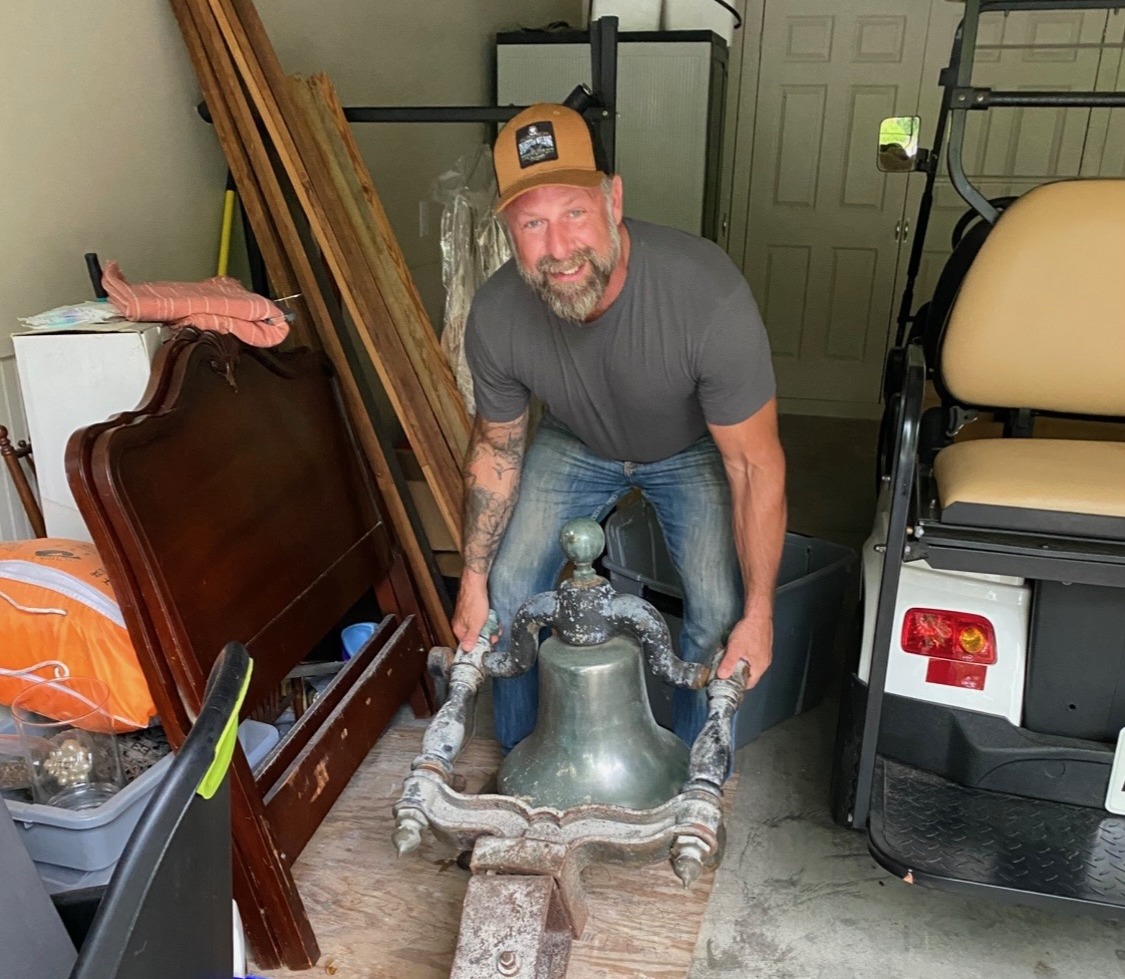
With Jim driving the restoration project, he put together a set of engineering sketches and worked closely with Brandon to restore the bell to its former glory. The plan was for it to rest in Larry and Susie’s new home's backyard. The bell itself is brass and hangs from an iron yoke, or headstock, that allows it to swing. The Birdie Bell has the original handle that would have reached back into the locomotive for the Engineer to pull to signal the train was arriving.
Brandon, whom Joe now refers all of his work to, took the old bell down to its original metal and restored it beautifully. Then he and Jim had to determine what the bell would stand on. At 300-plus pounds, it needed a substantial resting place at least six feet off the ground.
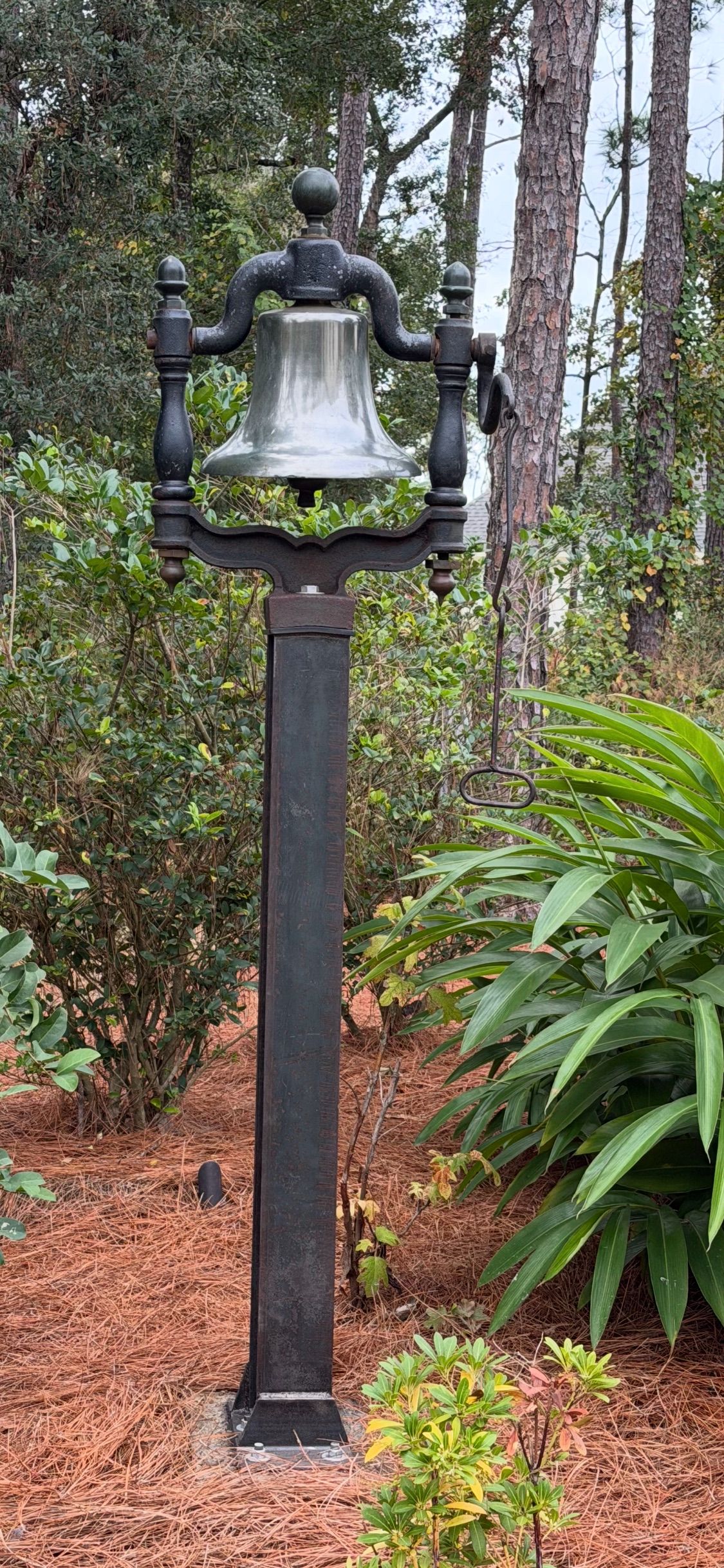
“We repurposed everything to keep the bell in its original form. I was rooting around in a big yard of old metal stuff one day and found an I-beam that we made into the bell stand. The Birdie Bell is now elegantly erected in Larry and Susie’s back yard surrounded by beautiful landscaping. It makes quite the statement!
You can see the pride emanating from the group as we discuss the project. Susie served as project manager, Jim was the technical advisor, Brandon did the restoration, and Larry cheered them on every step of the way. “The biggest challenge may have been lifting the bell onto its resting place,” says Brandon. “That’s a whole other story,” they tell me.
Brandon, who loves working with ornamental projects, has recently fabricated the railings at St. James Church in Fairhope, including the handrails and gates. He’s created wedding arches for florists and other metal decorative projects. You can reach Brandon Sylvester Welding, LLC by emailing sylvesterwelding24@gmail.com or calling him at 251 978-8466 in Foley.
“I get excited about repurposing old metal. I do all the design work. Any project, whether it's residential or commercial, I’d love to talk to you about it.” He tells me all of his business has been by word of mouth. “I have a mobile unit with all the equipment, so I can work on site anywhere in the Scenic 98 Coastal area. I’d like to get into more metal art projects in the future.”
In its foundry days, the bell rang at 8 am to start the work day, at noon to signal the lunch break, and at 5 pm to end the work day. It has served as the signal bell for an early steam locomotive, as a timekeeper at the foundry, as the Birdie Bell for golfers at Lakewood, and now as the Cocktail Bell at the Cerf’s home in Fairhope. What a fitting end to an illustrious journey!
More from
Community Endeavors
category