.jpg)


A few weeks ago, I ran into Paul Harriman at a St. Patrick’s Day party, and then again shortly after at a restaurant on a Sunday evening. We were having dinner with good friends, T.K. Jackson and Jeanie Miller. Paul greeted Jeanie and mentioned that he had recently come across an old article written by Vivian Cannon about her grandfather’s soft-shell crab farm on Weeks Bay. It had appeared in The Mobile Press-Register’s Sunday Magazine on September 2, 1962.
“I’d love to see that,” I told Paul. “I remember that place. My dad loved soft-shell crabs, and we used to drive down County Road 1 from our home in Point Clear to buy them.”
The next day, Paul emailed me copies he’d made from the archives. It took a bit of effort to read through the article in pieces, but once I did, it carried me straight back in time.
I remember, as a boy, floundering along the wharves on clear summer nights with a Coleman lantern—what we called a “floundering light.” It had a fragile mantle that burned bright, its glow reflecting off a large silver bowl attached to the fuel tank filled with white gas.

Carrying that lantern was serious business. One wrong bump against a piling and the mantle would shatter. We waded slowly through shallow water, scanning the sandy bottom for flounder. We carried single-prong gigs, a crab net, and a No. 2 galvanized wash tub for the catch.
My dad and two older brothers would ease along the shoreline, the bay so clear you could see everything—eels, needlefish, catfish, croakers, mullet weaving through the seagrass, oyster and clam shells buried in the sand. It felt like walking through an aquarium.
There were no jetties or bulkheads then. You only floundered when the wind was down and the water calm. A distant ship’s wake might roll in and cloud things up, and occasionally you’d spot a stingray or stinging nettles—but we knew how to steer clear.
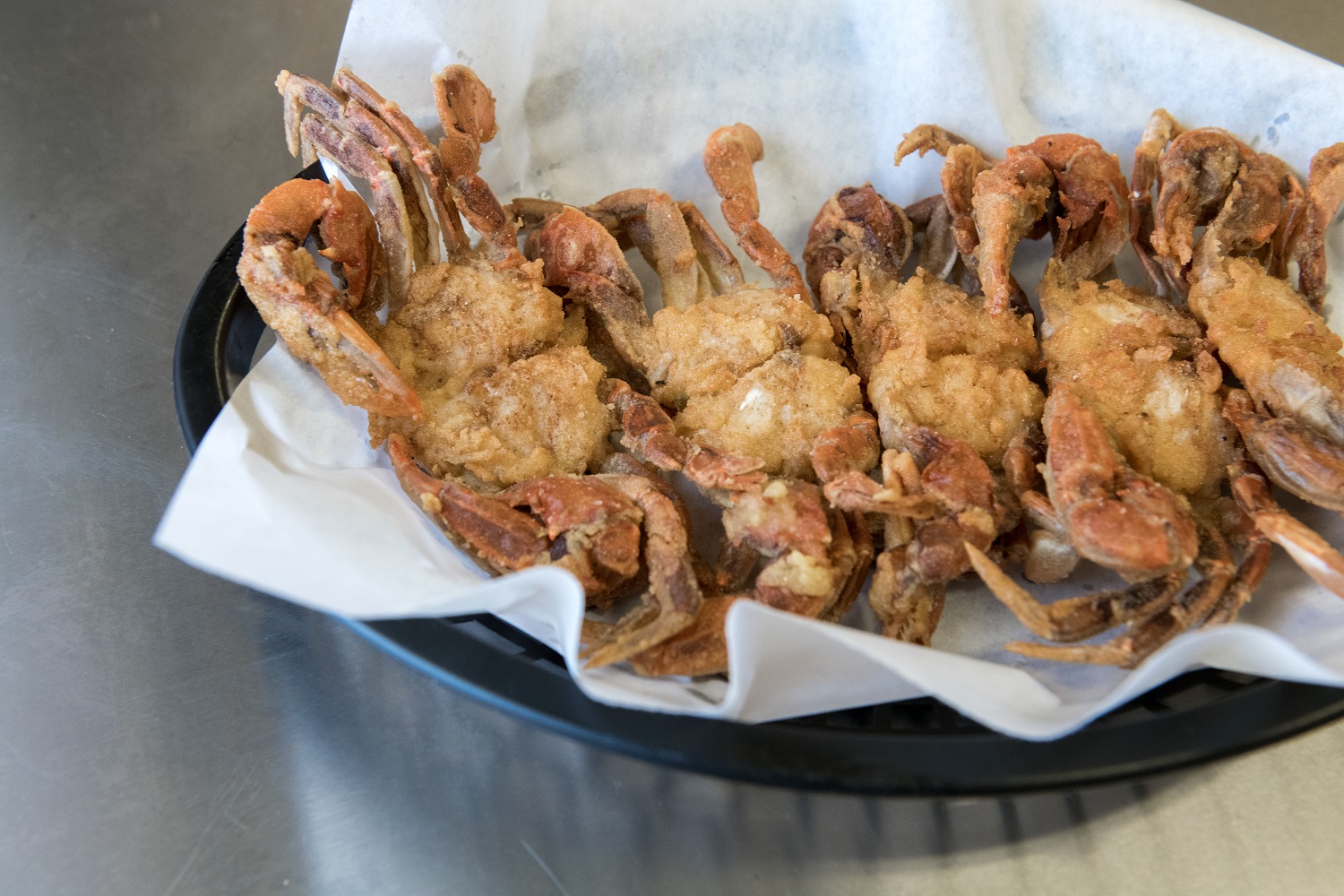
Gigging a flounder was never guaranteed. Some nights we’d bring home enough for a meal or two; others, nothing at all. But the real prize—the one that sent my dad into full celebration mode—was finding a soft-shell crab. It was like winning the lottery.
After a good night, we’d clean the catch, clean ourselves, and stretch out on old army cots on the sleeping porch. With nothing but a box fan and the warm, humid breeze, we’d drift off. I don’t think I’ve ever slept better.
All of that came rushing back when Paul mentioned the article about Jeanie’s grandfather’s crab farm.
I vaguely remember the “shedder” operation run by Harold Miller and his family near the mouth of Weeks Bay, where it meets Mobile Bay. A retired Navy captain with experience in the Chesapeake, Mr. Miller understood the delicate timing of crab shedding—the moment when crabs outgrow their shells and become the soft-shell delicacy prized by seafood lovers.
His setup was ingenious. He built two 50-foot pens on land and pumped roughly 8,000 gallons of bay water through them to keep the crabs alive as they approached the shedding stage. Each day, the crabs were sorted by size and monitored closely for subtle color changes that signaled they were about to shed.
Timing was everything.
When a crab reached the “buster” stage—the first sign it was ready to molt—it was moved into an individual cage for protection. The shedding process itself took only three to four hours. Once soft, the crab had to be quickly graded and placed into a cooler to preserve its delicate state. If the shell began to harden, it became what Miller called a “paper shell” and was no longer desirable.
The entire operation ran around the clock and involved the whole family. In the article, Miller explained that success depended on his ability to “read” the crabs—something he had taught his sons to do as well.
His wife Marian handled early morning checks. Pokey graded and sold crabs, David helped with sales and gave tours, and even young Katie had a role, catching “busters.” It was truly a family effort.
Unlike many crab farms that used floating bins, Miller built his pens waist-high on dry land—partly, he joked, because he didn’t want to wade. But the design also gave him greater control over the process. Since crabs can be cannibalistic—especially during shedding when they are most vulnerable—constant vigilance was essential.
Miller began the operation on May 29, 1962, and shed his first crab just ten days later. “We still have its shell,” he said proudly.
He shut things down each year with the first cold snap, returning to his work as an industrial salesman after serving as an operations officer for the Navy’s Atlantic Fleet in Norfolk.
Reading that article—and remembering those nights on the bay—felt like stepping into another world. A simpler one, maybe. But one filled with salt air, hard-earned meals, and the kind of memories that stay with you for a lifetime.
Now you know.
More from
Musings From The Cove
category